
On-Demand CE Training
EP 370: When Words Don’t Work: Art, Access, & the Fight Against Stigma
Please make sure to check with your own state board to ensure the transferability of CE credit for an asynchronous course. Some state boards may place restrictions regarding the modality of training required for ethics credits to be awarded. If this training indicates ethics credits are available, please verify that your state allows them to be earned through an on-demand course format.
1 CREDIT HOUR APPROVED FOR:
Social Workers
ASWB ACE – 1 General Continuing Education Credit
New York State Education Department’s State Board for Social Work- 1 Contact Hour
Psychologists
APA – 1 CE Credit
Counselors
NBCC ACEP – 1 Contact Hour
New York State Education Department’s State Board for Mental Health Practitioners- 1 Contact Hour
Addiction Professionals
NAADAC – This course is not approved for NAADAC contact hours.
Nurses
California Board of Registered Nursing – This course is not approved for nursing contact hours.
Case Managers
CCMC – This course is not approved for CCMC contact hours.
Important Notice: The podcast included in this continuing education course was originally published by Behavioral Health Today and is used with permission. Continuing education credit is available only through successful completion of the CEU Creations course requirements, including any required assessments or evaluations. Listening to the podcast through Behavioral Health Today or any other platform does not qualify for CE credit.
Created On: 10/9/26
Target Audience:
This course is targeted for social workers, psychologists, and counselors.
Instructional Level:
Intermediate
Overview:
This continuing education course explores the role of creativity, cultural responsiveness, and accessibility in expanding mental health care beyond traditional talk-based approaches. Drawing from the Behavioral Health Today episode “When Words Don’t Work: Art, Access, & the Fight Against Stigma” with Manami Yamamoto, MA, LMFT, the course examines how clinicians can create safe, inclusive environments that allow clients to express and process experiences when verbal communication alone may be insufficient.
Participants will consider the use of creative and expressive therapeutic approaches as tools for fostering connection, emotional expression, and engagement across diverse populations. The course also addresses mental health stigma within minority and underserved communities, along with systemic barriers that can limit access to education, treatment, and supportive services. Emphasis is placed on culturally attuned practice, reducing barriers to care, and recognizing multiple pathways through which healing and psychological well-being can occur.
Outline:
- Introduction to Art-Based and Expressive Approaches
- When Verbal Communication Is Not Enough
- Creativity as a Tool for Emotional Expression
- Cultural Factors in Mental Health Treatment
- Mental Health Stigma in Underserved Communities
- Barriers to Accessing Behavioral Health Services
- Building Culturally Responsive and Inclusive Care
- Supporting Multiple Pathways to Healing
Course Objectives:
By the end of the session, the participant will be able to:
- Describe how creative and expressive therapeutic approaches can facilitate emotional communication, engagement, and psychological healing when traditional verbal interventions are insufficient.
- Identify cultural, systemic, and stigma-related barriers that may reduce access to mental health services among minority and underserved populations.
- Apply principles of culturally responsive and inclusive care to create therapeutic environments that promote safety, accessibility, connection, and individualized pathways to healing.
Guest:
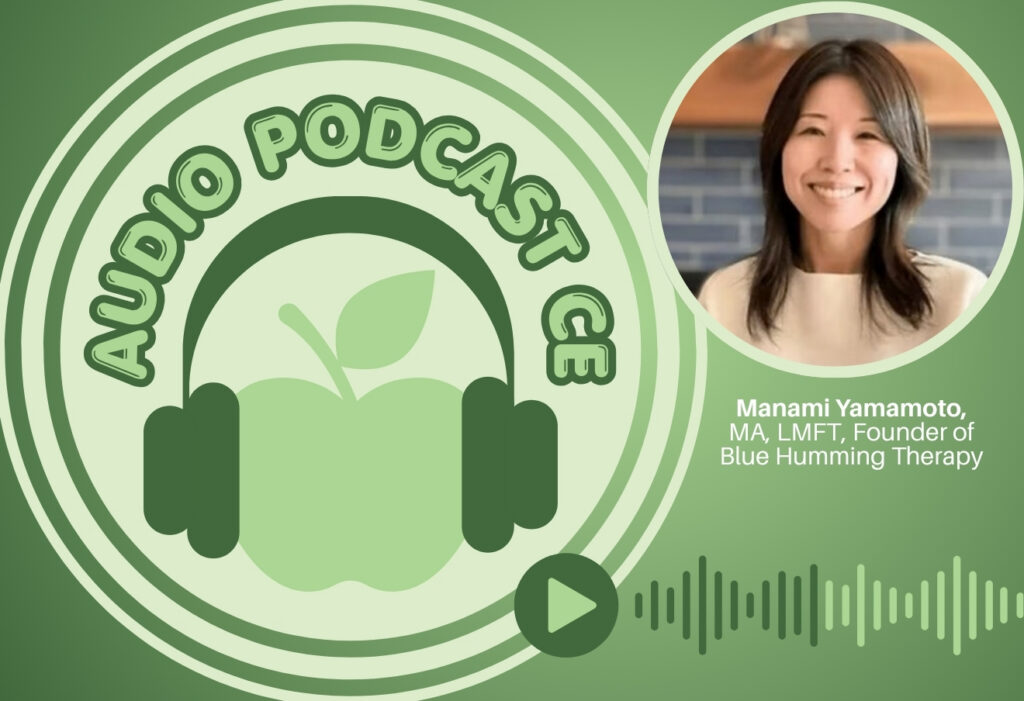
Manami Yamamoto, MA, LMFT, Founder of Blue Humming Therapy
Manami Yamamoto is the Founder and Director of Blue Humming Therapy. She is a Licensed Marriage and Family Therapist and an Expressive Arts Therapist, and she also founded and directs the Mental Health Environment Improvement Project. She holds a Bachelor’s degree in Psychology from the University of California, Berkeley, and a Master’s degree in Counseling Psychology and Expressive Arts Therapy from the California Institute of Integral Studies.
In addition to her clinical practice, she provides seminars, lectures, and training for companies, schools, and organizations in the United States and internationally, focusing on psychoeducation and reducing barriers to care. Since the Covid 19 pandemic, her advocacy and community work have expanded beyond the US to Japan and India, where she continues to support minority communities and promote environments where mental health support is available across borders.
Her international collaborations have been featured globally, reflecting her ongoing mission to address bias and stigma and to help create a world where mental health support is equally accessible to all.