
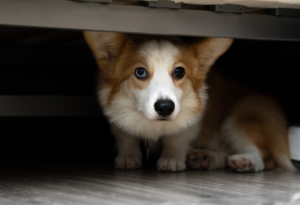
Anxiety and stress aren’t limited to humans; animals experience them too. With the Fourth of July coming up, we turn our attention to the four-legged family members, because for pets, the holiday can be one of the most frightening days of the year.
Animal shelters across the United States report a 30%–60% increase in lost pets between July 4 and July 6, and July 5 is consistently one of the busiest days of the year for stray dog intakes. Fireworks are one of the biggest reasons why otherwise well-behaved pets panic and run away. (American Animal Hospital Association [AAHA], 2024; Shelter Animals Count, 2025).
Is Your Pet Stressed?
Some signs of stress are obvious:
- Trembling or shaking
- Whining, barking, or yowling
- Trying to hide
- Pacing
- Attempting to escape
But many other signs are just as important yet can be easily overlooked:
- Excessive panting when it’s not hot
- Lip licking or repeated yawning
- Dilated pupils
- Refusing treats or food
- Becoming unusually clingy or unusually withdrawn
- Restlessness or inability to settle
Cats, in particular, often respond by disappearing under furniture or into closets rather than vocalizing their fear. Because their stress can be quieter, it’s easy to assume they’re coping well when they’re actually experiencing significant anxiety.
The Safest Place Is Home
Veterinarians and animal welfare organizations overwhelmingly recommend keeping pets indoors during fireworks displays. Before the celebrations begin:
- Walk dogs early in the day before neighborhood fireworks start.
- Close windows, curtains, and blinds to reduce flashes and noise.
- Turn on a television, fan, or calming music to help mask the sounds outside.
- Create a quiet “safe space” with favorite blankets, toys, or a crate if your pet already sees it as a secure retreat.
- Double-check that doors, gates, and windows are securely closed, especially if you’ll have guests coming and going.
Even pets that have never tried to escape before can bolt when startled by a loud explosion.
What If You Want to Bring Your Pet?
The simplest advice is: don’t. Public fireworks displays combine loud noises, crowds, unfamiliar smells, children running, dropped food, and flashing lights – all things that can overwhelm even a confident animal.
If you absolutely must bring your pet:
- Keep them on a secure leash or in a well-ventilated carrier at all times.
- Make sure they wear an ID tag with your current phone number.
- Have them microchipped and verify that your contact information is up to date.
- Bring fresh water and avoid crowded areas when possible.
- Be prepared to leave immediately if your pet begins showing signs of stress.
Microchips are especially important because collars and harnesses can slip off during a panic. A microchip provides permanent identification that greatly improves the chances of being reunited if your pet gets lost (American Veterinary Medical Association [AVMA], n.d.).
“But My Pet Loves Fireworks!”
Some owners insist their dog sleeps through fireworks every year, or that their cat watches them from the window without concern. That certainly happens, but it’s worth asking: Are you sure?
Animals often express stress differently than humans expect. A dog sitting quietly may actually be frozen in fear. A cat watching the window may be hypervigilant rather than fascinated.
If your pet truly remains relaxed, that’s wonderful. Even then, it’s still wise to keep them securely contained, since a single unexpected blast or nearby firework can produce a very different reaction than in years past.
If You Find a Lost Pet During the Holiday
The same fireworks that frighten your own pet may send someone else’s running. If you come across a loose dog or cat, your first instinct may be to chase after it, but that can actually cause a frightened animal to run farther or into traffic. Instead:
- Stay calm and avoid sudden movements.
- If the animal seems approachable, speak softly and offer treats or water if you have them.
- If it’s safe to do so, secure the pet with a leash or guide it into a fenced yard, garage, or other enclosed space until help arrives.
- Check for an ID tag and call the owner immediately if contact information is available.
- If there is no visible identification, take the pet to a veterinarian or animal shelter to be scanned for a microchip. Many will do this free of charge.
- Report the found pet to your local animal shelter or animal control agency, and consider posting clear photos and the location where the pet was found in reputable local lost-and-found pet groups.
Remember that even the friendliest pet may react unpredictably when frightened. Protect yourself as well as the animal, and don’t put yourself in danger by entering traffic or attempting to catch an aggressive or severely distressed pet. A few minutes of kindness and patience can make all the difference in helping a scared pet find its way back home.
Can Pets Get Used to Fireworks?
Sometimes.
Behaviorists often recommend gradual desensitization, which involves playing recordings of fireworks at a very low volume while pairing the sounds with treats, toys, or other positive experiences. Over time – and never by forcing exposure – the volume can be increased gradually. This process is most successful when started well before fireworks season.
For pets with severe noise anxiety, talk with your veterinarian. Prescription anti-anxiety medications, pheromone products, anxiety wraps, or other treatment options may be appropriate.
You may also have seen “noise-canceling headphones” marketed for dogs. While hearing protection for pets does exist, experts generally view it as an adjunct, not a substitute, for proper training, environmental management, and veterinary guidance. Some dogs tolerate them well, while others find wearing them stressful.
A little planning before the first firework launches can help ensure that everyone – including your four-legged family members – has a safer, calmer holiday.
References
- American Animal Hospital Association. (2024). Fireworks aren’t fun for everyone. https://www.aaha.org/newstat/publications/fireworks-arent-fun-for-everyone/
- American Veterinary Medical Association. (n.d.). July 4 safety. https://www.avma.org/resources-tools/pet-owners/petcare/july-4-safety
- Shelter Animals Count. (2025). Stray dog intakes spike after July 4th, new data from Shelter Animals Count confirms.